

Bank statements provide lenders with a direct view of a borrower's financial activity, making them one of the most valuable documents in loan underwriting. They reveal how money moves through a business, whether deposits are consistent, how expenses affect available cash, and whether the borrower can meet financial obligations.
For lenders, merchant cash advance (MCA) providers, and commercial financing companies, reviewing bank statements is about more than checking balances. It requires identifying red flags such as unusual deposits, unexplained transfers, altered documents, and inconsistent financial information while recognizing green lights that indicate stable cash flow and repayment capacity.
A structured bank statement underwriting playbook helps teams review applications consistently, identify potential fraud earlier, and prepare cleaner, funder-ready submissions.
This guide explains how underwriters can identify red flags and green lights, automate bank statement analysis, detect suspicious documents, and use financial data to make better lending decisions.
What Is Bank Statement Underwriting?
Bank statement underwriting is the process of evaluating a borrower's financial condition, cash flow, and repayment capacity by reviewing bank transaction records.
Unlike traditional underwriting that may rely heavily on tax returns, financial statements, and credit reports, bank statement underwriting focuses on actual money entering and leaving a bank account.
This approach is particularly useful for small businesses, self-employed borrowers, and merchant cash advance applicants whose reported income may not fully reflect their current financial activity.
What Do Underwriters Look for in Bank Statements?
Underwriters generally examine several financial indicators to determine whether an applicant meets the lender's requirements.
| Financial indicator | What it tells the underwriter | Financial indicator |
| Average monthly deposits | The amount of money entering the account | Average monthly deposits |
| Deposit consistency | Whether revenue remains stable over time | Deposit consistency |
| Ending balances | How much cash remains at the end of each period | Ending balances |
| Average daily balance | Whether the business maintains sufficient liquidity | Average daily balance |
| NSF and overdraft activity | Whether the borrower experiences cash shortages | NSF and overdraft activity |
| Existing loan payments | The financial burden of current obligations | Existing loan payments |
| Transaction patterns | Whether account activity appears consistent with business operations |
These indicators help lenders understand the difference between a business that generates consistent revenue and one that relies on irregular deposits or temporary cash injections.
Red Flags: 10 Warning Signs Underwriters Should Never Ignore
A red flag does not automatically mean a borrower has committed fraud or cannot repay a loan. It means the information requires further investigation before the lender makes a decision.
The strongest underwriting processes combine several warning signs rather than rejecting applications based on a single unusual transaction.
1. Abnormal Deposit Patterns
One of the most important warning signs is a sudden increase in deposits that does not match the borrower's normal business activity.
For example, a business that typically receives $25,000 to $35,000 in monthly deposits suddenly reports $90,000 in deposits without a clear explanation.
This increase may represent genuine business growth, a seasonal sales spike, a one-time contract, or an unusual financial event. However, it could also indicate borrowed funds, transfers between accounts, or artificial revenue inflation.
Underwriters should examine:
- Large deposits that differ significantly from historical activity
- Repeated deposits with identical amounts
- Deposits occurring outside normal business patterns
- Sudden increases near the loan application date
- Deposits that are quickly withdrawn or transferred elsewhere
Best practice: Compare deposit activity across multiple statement periods and identify whether unusual deposits have a legitimate business explanation.
2. Frequent NSF Fees and Overdrafts
Non-sufficient funds (NSF) fees and overdrafts can indicate that a business struggles to maintain enough cash to cover its financial obligations.
A business may generate substantial monthly revenue but still experience cash shortages because of high operating expenses, poor payment timing, or excessive debt.
For example, a business generating $70,000 in monthly deposits but experiencing 12 overdraft incidents may require closer examination than a business generating $45,000 with stable balances and consistent cash flow.
Underwriters should assess the frequency, severity, and timing of overdrafts rather than relying only on the total number of incidents.
3. Unexplained Large Transfers
Transfers between bank accounts can make a borrower's financial position appear stronger than it actually is.
For instance, a business owner might transfer $40,000 from a personal account into a business account shortly before submitting a financing application.
The deposit increases the account balance, but it does not necessarily represent business revenue.
Underwriters should identify:
- Transfers between accounts owned by the same borrower
- Deposits followed by matching withdrawals
- Funds received from unrelated third parties
- Transfers that lack supporting documentation
- Repeated movement of funds between accounts
The key is to distinguish genuine operating revenue from internal transfers, borrowed money, and other non-revenue transactions.
4. Inconsistent Monthly Revenue
A healthy business does not necessarily generate identical revenue every month. Seasonal businesses, construction companies, and service providers may experience natural fluctuations.
However, unexplained revenue changes can indicate financial instability or inaccurate reporting.
Consider a business with the following monthly deposits:
| Month | Deposits |
| January | $42,000 |
| February | $39,500 |
| March | $41,200 |
| April | $18,000 |
| May | $21,500 |
| June | $19,800 |
The decline may reflect seasonal demand, lost customers, operational problems, or changes in account activity.
Underwriters should compare the trend with historical statements, business type, and supporting financial information before reaching a conclusion.
5. Existing MCA or Loan Obligations
Multiple financing agreements can significantly affect a business's available cash flow.
For MCA applicants, underwriters should identify existing daily or weekly remittances, recurring loan payments, and other obligations that reduce available funds. A business receiving $50,000 in monthly deposits may have limited repayment capacity if several financing providers already collect substantial amounts from its bank account.
The underwriting team should calculate the remaining cash flow after accounting for existing obligations rather than evaluating deposits alone.
6. Missing Statement Pages
Missing pages can prevent lenders from understanding the full financial picture. A statement may show a strong opening balance and substantial deposits while omitting the pages containing withdrawals, loan payments, overdrafts, or ending balances.
Underwriters should verify that:
- Every expected page is present
- Page numbering is sequential
- Opening and closing balances reconcile
- Transaction records cover the complete statement period
Missing pages should trigger a request for a complete document rather than an immediate assumption of fraud.
7. Suspicious Document Modifications
Altered bank statements are a serious concern because even small changes can affect lending decisions. Common warning signs include inconsistent fonts, misaligned text, unusual spacing, overwritten balances, and transaction descriptions that appear different from the surrounding content.
However, these visual differences are not conclusive evidence. Statements may be converted, compressed, or processed by legitimate software.
Document verification should combine visual inspection, PDF metadata, transaction reconciliation, and comparison with original bank-issued records where possible.
8. Repeated or Duplicate Transactions
Duplicate transactions can inflate reported revenue or exaggerate financial activity.
For example, the same $8,500 deposit may appear twice in a statement or across multiple submitted documents.
Automated systems can flag transactions with matching dates, amounts, descriptions, and reference numbers. Underwriters can then determine whether the records represent genuine separate payments or duplicated information.
9. Unusual Cash Deposits
Cash deposits are not automatically suspicious, particularly for restaurants, retail stores, and businesses that regularly handle physical payments.
However, unusually large cash deposits may require additional documentation.
Underwriters should compare cash deposits with the business model, historical activity, sales records, and other available financial information.
10. Negative or Declining Ending Balances
A declining ending balance can indicate that a business is using more cash than it generates.
A borrower may show strong deposits but finish each month with less available cash, suggesting that expenses and financing obligations exceed operating inflows.
Underwriters should review both ending balances and average daily balances to understand whether the business maintains sufficient liquidity throughout the month.
Green Lights: 6 Positive Signals That Support Loan Approval
While identifying red flags is essential, underwriters must also recognize positive financial indicators that demonstrate a borrower's ability to repay financing.
A strong application typically shows consistent operating revenue, manageable expenses, sufficient liquidity, and a clear history of meeting financial obligations. These signals should be evaluated together, with adjustments for business type, seasonality, and the lender's credit policy.
1. Consistent Operating Revenue
Regular deposits from customers, payment processors, and business operations indicate that the company has an established revenue stream.
For example, a business receiving $40,000 to $48,000 in monthly operating deposits over six consecutive months may demonstrate more predictable cash flow than one reporting $100,000 in a single month followed by several months of low activity.
2. Healthy Average Daily Balances
Average daily balance (ADB) helps lenders understand how much money a business maintains throughout the month.
A business that finishes each month with $15,000 but regularly falls below $1,000 during the month may face liquidity pressure that a month-end snapshot would miss.
A healthy ADB relative to operating expenses and proposed repayment obligations can indicate that the borrower has a reasonable cash cushion.
3. Low NSF and Overdraft Activity
Few or no overdrafts suggest that the business generally manages its cash flow without repeatedly exhausting available funds. Underwriters should still consider the size and timing of any overdraft. A single incident caused by a delayed customer payment may have a different meaning from recurring overdrafts associated with excessive debt.
4. Clear and Verifiable Revenue Sources
Deposits that can be linked to identifiable customers, payment processors, invoices, or business operations provide stronger evidence of genuine revenue.
This is particularly important for MCA applications, where the lender may base the advance amount on expected future receivables.
5. Manageable Existing Debt
A borrower with limited existing debt may have more cash available to support new financing.
Underwriters should identify recurring lender payments, credit card obligations, and other financial commitments before estimating the borrower's remaining repayment capacity.
6. Stable Operating Expenses
Predictable payroll, rent, supplier payments, and other operating costs help lenders estimate the amount of cash available after business expenses.
A business with rising revenue but sharply increasing expenses may not have improved its repayment capacity.
Can MoneyThumb Automatically Build Clean, Funder-Ready Loan Packets?
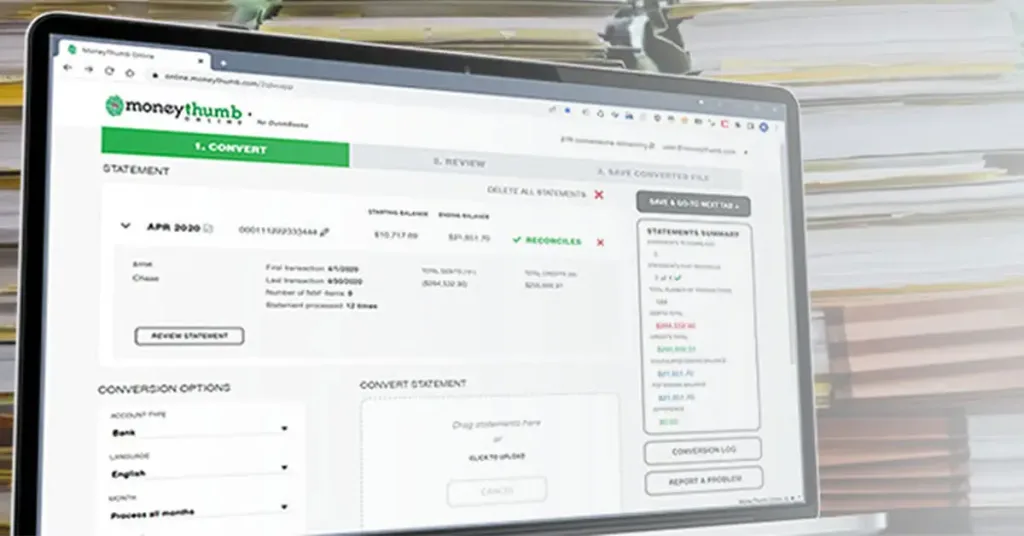
Yes. MoneyThumb offers financial document processing and underwriting tools that can help lenders convert messy bank statement submissions into structured financial data, standardized reports, and underwriting-ready information.
Its PDF Insights product processes bank statements, extracts transaction data, reconciles balances, identifies relevant financial activity, and produces underwriting scorecards. The platform also supports workflow integration through APIs and other available intake methods.
How MoneyThumb Helps Prepare Loan Submissions
A typical workflow involves five stages.
- Document intake
Receive bank statements and supporting financial documents through the available upload or integration process.
- Data extraction
Extract account information, transactions, balances, and statement summaries from supported PDF documents and scanned files.
- Reconciliation and fraud checks
Check financial totals, identify potential document inconsistencies, and flag transactions requiring review.
- Financial analysis
Categorize transactions, identify true revenue, calculate cash flow indicators, and generate underwriting scorecards.
- Structured output
Deliver standardized financial data and reports for review, export, or integration into the lender's workflow.
Can It Handle Messy Loan Submissions?
MoneyThumb's PDF Insights is designed to process different bank statement formats, including scanned or image-based PDFs. Its OCR technology can identify questionable fields and flag transactions for review. This can help underwriting teams reduce repetitive data entry and spend more time investigating material issues.
For lenders receiving large numbers of applications, the biggest operational benefit is consistency: applications can pass through the same document processing and analysis steps rather than depending entirely on individual underwriters.
Can MoneyThumb Help Improve the Fundability Score of MCA Applications?
MoneyThumb can help lenders and MCA brokers identify financial information that affects an application's fundability. However, it is important to distinguish between improving the quality of an application and changing a lender's actual credit decision.
MoneyThumb does not guarantee loan approval or increase a borrower's creditworthiness simply by processing bank statements. Its value comes from helping users understand the financial information more accurately and identify issues that may affect underwriting.
What Is an MCA Fundability Score?
An MCA fundability score is an assessment of how suitable a business may be for merchant cash advance financing.
The exact scoring method varies by funder. It may consider revenue, cash flow, existing financing, payment history, account balances, and other risk factors.
| Factor | Why it matters |
| Monthly qualifying revenue | Indicates the business's sales activity |
| Average daily balance | Shows available cash throughout the month |
| Existing MCA positions | Reveals current financing obligations |
| NSF and overdraft frequency | Indicates possible cash flow stress |
| Deposit consistency | Helps assess revenue stability |
| Debt-to-revenue burden | Shows how much revenue is committed to existing payments |
| Document authenticity | Supports confidence in the submitted information |
How MoneyThumb Supports MCA Fundability Analysis
MoneyThumb's MCA-focused tools can identify true revenue, recurring financing payments, low-balance activity, overdrafts, and other relevant risk indicators.
These findings help brokers and funders understand the applicant's financial position before making a financing decision.
For example, consider a business with $60,000 in monthly gross deposits.
After reviewing its bank statements, the underwriting team identifies:
- $12,000 in transfers between owned accounts
- $8,000 in loan proceeds
- $5,000 in returned or reversed deposits
The adjusted revenue calculation would be:
| Calculation | Amount |
| Gross deposits | $60,000 |
| Less internal transfers | −$12,000 |
| Less loan proceeds | −$8,000 |
| Less returned or reversed deposits | −$5,000 |
| Adjusted revenue for review | $35,000 |
This example is illustrative. Actual qualifying revenue depends on the lender's policy and transaction classification.
The adjusted figure provides a more useful starting point for evaluating the business's financing capacity than gross deposits alone.
How to Integrate Bank Statement Automation Into an Existing LOS
Loan origination system (LOS) integration is an important consideration for lenders evaluating bank statement analysis software.
The objective is to reduce duplicate work while preserving the existing application and underwriting process.
MoneyThumb provides API access to its financial processing capabilities, allowing lenders to retrieve structured data and underwriting information for use in their workflows.
What Is a Typical Implementation Timeline?
Implementation time depends on the lender's technical requirements, document volume, security review, and the complexity of its LOS.
The following ranges are general planning estimates, not verified MoneyThumb implementation commitments.
| Integration type | Illustrative planning range |
| Manual processing and basic workflow setup | 1–2 weeks |
| Standard API integration | 4–8 weeks |
| Complex LOS integration with custom workflows | 8–16 weeks or longer |
Lenders should request a project-specific timeline, pricing structure, and technical scope from the vendor before committing to implementation.
Conclusion: Building a Better Bank Statement Underwriting Process
A reliable bank statement underwriting process requires more than checking deposits and ending balances. Lenders must understand where money comes from, how it moves through the business, and whether the borrower has enough cash flow to support existing and proposed financing.
The strongest approach combines automated financial analysis, document verification, historical transaction comparison, and experienced underwriting judgment.
MoneyThumb can support this process through PDF Insights, transaction categorization, reconciliation, scorecards, and Thumbprint fraud analysis. These capabilities can help lenders prepare cleaner submissions, identify inconsistencies earlier, and reduce repetitive financial data entry.
Frequently Asked Questions
- What are the biggest red flags in bank statements for underwriters?
The most common warning signs include unexplained large deposits, frequent overdrafts, recurring NSF fees, inconsistent revenue, undisclosed financing payments, missing statement pages, and suspicious document modifications. A single warning sign does not necessarily indicate fraud, but it should be investigated.
- Can AI automatically detect fraudulent bank statements?
AI-based systems can identify potential document alterations, unusual transaction patterns, duplicated entries, and mathematical inconsistencies. However, no automated system guarantees that every fraudulent document will be detected. Human review and source verification remain important.
- Can MoneyThumb prepare funder-ready MCA application packets?
MoneyThumb can process bank statements, extract and categorize transactions, reconcile financial data, and generate underwriting scorecards. These capabilities can support the preparation of organized financing submissions, although the exact packet contents depend on the lender's requirements and workflow configuration.
- How can bank statement analysis improve MCA fundability?
Bank statement analysis helps brokers and funders understand qualifying revenue, cash flow, existing financing obligations, and financial risk indicators. It can help identify documentation gaps and support more accurate application assessments, but it cannot guarantee approval or change a lender's credit decision.
References
The following resources provide additional information on bank statement analysis, fraud detection, cash flow assessment, and lending decisions.
- https://bankscanpro.com/blog/bank-statement-analysis-for-mortgage-underwriting
- https://bankstatement.app/bank-statement-analysis-credit-risk-assessment/
- https://bankstatement.app/using-bank-statement-analysis-loan-approval/
- https://bankstatementgenerator.org/how-to-spot-modifying-bank-statements-a-guide-for-lenders-bankstatementgenerator/
- https://bankstatemently.com/blog/bank-statement-analysis-lending-decisions
- https://www.moneythumb.com/pdf-insights/
- https://www.moneythumb.com/thumbprint/
- https://docs.moneythumb.com/welcome/thumbprint
- https://www.moneythumb.com/moneythumb-online-pdf-insights
- https://www.moneythumb.com/blog/detect-loan-application-fraud-with-automated-bank-statement-processing












Add comment