

Automated cash flow reporting can help lenders reduce manual bank statement reviews, identify financial risks earlier, and make loan decisions faster. However, successful adoption depends on more than accurate data extraction.
The best approach is to use automation for data extraction, transaction classification, cash flow calculations, and risk alerts while keeping human underwriters responsible for complex decisions. With proper validation, transparent reporting, and consistent review procedures, lenders can reduce repetitive work without losing control over credit risk.
This article explains how lenders can build underwriter confidence in automated cash flow reporting, detect non-sufficient funds (NSF) activity, reduce underwriting backlogs with MoneyThumb, and improve merchant cash flow screening.
Why Underwriter Confidence Matters in Automated Cash Flow Reporting
Bank statements contain important information about a borrower's financial condition. They show deposits, withdrawals, transfers, recurring expenses, loan payments, overdrafts, and available balances. Reviewing these details manually can take considerable time, especially when lenders receive multiple statements from different banks.
Automated cash flow reporting helps organize this information into structured financial data. Instead of calculating deposits and expenses line by line, underwriters can review categorized transactions, monthly summaries, average balances, and potential risk indicators.
However, automation introduces a question that lenders cannot ignore: are the reported figures accurate enough to support a lending decision?
Underwriter confidence depends on three main factors:
- Accuracy: Extracted transactions and calculated totals must match the original bank statements.
- Transparency: Underwriters should be able to trace reported figures back to individual transactions.
- Consistency: The same classification rules and review standards should apply across applications.
When these conditions are met, automated reports become useful underwriting evidence rather than another document that employees must independently recreate.
- How Lenders Automate NSF Detection and Cash Flow Risk Analysis
Non-sufficient funds (NSF) activity is an important indicator in bank statement underwriting because it can reveal problems with available cash, payment timing, or existing financial obligations. An NSF event generally occurs when an account doesn't have enough available funds to cover a payment or withdrawal.
Traditionally, underwriters identify these events by searching bank statements for terms such as NSF, returned payment, insufficient funds, overdraft, and returned ACH. When an applicant submits several months of statements, manually finding and comparing these entries becomes time-consuming.
Which NSF and Cash Flow Indicators Should Automated Systems Track?
A reliable cash flow review should look beyond the number of NSF transactions. One isolated returned payment may have a different meaning from repeated failed payments across several months.
Lenders should monitor several indicators together to understand the applicant's financial position.
| Indicator | What it tells underwriters | Why it matters |
| NSF transactions | Payments returned due to insufficient funds | May indicate liquidity problems |
| Overdraft activity | Account spending exceeds available funds | Shows possible cash shortages |
| Negative daily balances | Periods when the account balance is below zero | Highlights financial pressure |
| Declining deposits | Reduced incoming funds over time | May indicate weakening revenue |
| Irregular deposits | Large or inconsistent incoming payments | Requires revenue verification |
| Recurring loan payments | Existing debt obligations | Helps assess repayment capacity |
The system should also distinguish between NSF fees, overdraft fees, returned deposits, and actual returned payments. These entries aren't interchangeable, and counting them incorrectly can produce misleading risk assessments.
How Does Automated NSF Detection Work?
A typical automated workflow begins when the lender receives PDF bank statements from an applicant. The software reads the documents, extracts transaction details, and assigns categories based on transaction descriptions and classification rules.
After extraction, the system can identify NSF-related entries, calculate their frequency, and compare activity across statement periods. It can also examine whether the applicant's deposits are sufficient to cover recurring expenses and debt payments.
For example, consider a business with the following activity:
| Monthly indicator | January | February | March | Monthly indicator |
| Total deposits | $42,000 | $38,000 | $31,000 | Total deposits |
| Total withdrawals | $35,000 | $36,000 | $32,500 | Total withdrawals |
| NSF transactions | 0 | 2 | 4 | NSF transactions |
| Ending balance | $7,000 | $4,000 | $1,500 | Ending balance |
The figures show declining deposits, increasing NSF activity, and a falling ending balance. An automated report can bring these patterns to the underwriter's attention without requiring a manual search through every transaction.
How MoneyThumb's PDF Analysis Reduces Manual Underwriting Backlogs
Manual bank statement processing often creates delays before an application reaches the actual credit decision stage. Underwriters may spend considerable time opening PDF files, checking balances, entering transaction amounts, identifying deposits, and calculating monthly revenue.
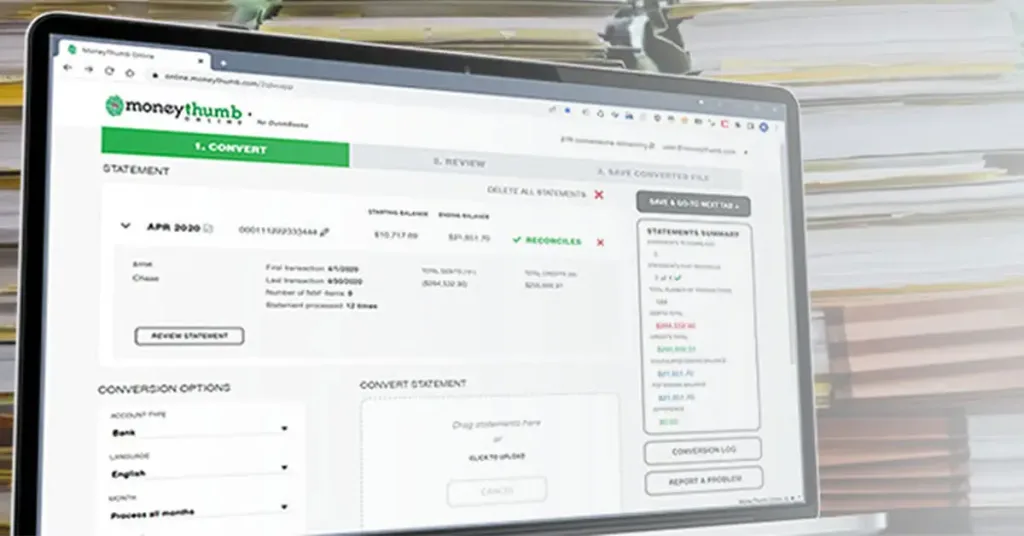
MoneyThumb's PDF Insights is designed to automate much of this document-processing work.
According to its product documentation, MoneyThumb converts financial documents into structured data, categorizes transactions, supports scanned and image-based statements, and provides outputs that can be used by downstream underwriting systems.
What Happens When a Bank Statement Enters MoneyThumb?
MoneyThumb's documented processing lifecycle includes five main stages: intake, conversion, tagging, scorecard, and output.
Document intake
Bank statements enter through supported submission methods, including API-based workflows and other integrations.
PDF conversion and extraction
The system reads statement information and converts it into structured financial records. OCR supports image-based documents.
Transaction tagging
Deposits, withdrawals, transfers, payroll, NSF activity, and other transactions are categorized.
Financial analysis and scorecard
Extracted information can feed cash flow calculations, financial ratios, and lender-defined underwriting rules.
Structured output
Results can be delivered through supported formats and integrations for further underwriting review.
This workflow reduces the amount of repetitive data entry required from underwriting teams. Instead of manually preparing every financial summary, employees can begin with organized information and focus on the issues that need judgment.
How Does Statement Reconciliation Help?
One important feature in automated statement analysis is reconciliation. MoneyThumb's documentation describes a check based on the following accounting relationship:
\[ \text{Opening Balance}+\text{Deposits}-\text{Withdrawals} =\text{Closing Balance} \]
If the extracted figures don't match the reported statement balance, the document or extraction result may require further investigation.
For example, if an account begins with $12,000, receives $20,000 in deposits, and records $25,000 in withdrawals, its expected ending balance is $7,000.
If the statement reports $9,000, the difference needs to be investigated. It could result from missing transactions, an extraction error, an incorrect statement period, or a document issue.
Reconciliation doesn't prove that a statement is genuine, but it provides an important financial consistency check.
How to Get Underwriters to Trust Automated Cash Flow Summaries
Getting underwriters to trust automated reporting requires more than introducing new software. Employees need evidence that the system produces reliable financial information and that they can investigate questionable results whenever necessary. A common mistake is expecting underwriters to accept automated summaries without showing them where the figures came from. If an automated report shows $65,000 in monthly revenue, the reviewer should be able to identify the deposits that make up that amount and distinguish actual business income from transfers or borrowed funds.
The following strategies can help lenders establish that confidence.
Strategy 1: Make Every Financial Figure Traceable
Every important figure in an automated report should have a clear source. Underwriters should be able to move from a monthly cash flow summary to individual transactions and, when needed, the corresponding statement page.
For example, if the system identifies $65,000 in deposits, the report should help the reviewer understand:
- Which transactions were included in the total.
- Which deposits were excluded and why.
- Whether internal transfers were removed.
- Whether refunds or loan proceeds were counted as revenue.
- Which statement periods were used.
This level of visibility helps underwriters identify classification mistakes instead of questioning the entire report.
Strategy 2: Compare Automated Results With Manual Reviews
Before allowing automation to handle a large share of incoming applications, lenders should test it against manually reviewed statements.
A practical validation process involves selecting a sample of applications and asking experienced underwriters to calculate key financial figures independently. The team can then compare those results with the automated reports.
Strategy 3: Create Clear Exception-Based Review Rules
Underwriters don't need to manually inspect every application to maintain control over lending risk. Instead, lenders can establish review rules that determine which applications require additional attention.
For example, an application could be sent for manual review when:
- The opening and closing balances don't reconcile.
- Multiple NSF transactions appear within a short period.
- Monthly deposits show a significant decline.
- Unusually large deposits cannot be identified.
- A statement receives a concerning document fraud result.
- The system cannot confidently classify important transactions..
Strategy 4: Give Underwriters Control Over Classification Corrections
Automated categorization isn't always perfect. A transaction described as a transfer could represent an owner's contribution, an internal movement between accounts, or money received from another business.
Underwriters should have a defined process for correcting these classifications. Their corrections should also be recorded so the lender can identify repeated errors and improve its review procedures.
MoneyThumb's product documentation lists transaction tagging and tag editing among its capabilities. This is relevant when lenders need to review or correct transaction classifications before relying on financial summaries.
How Top ISOs Pre-Screen Merchant Cash Flow Data for Funder Requirements
Independent Sales Organizations (ISOs) play an important role in the merchant cash advance (MCA) industry. They connect business owners seeking funding with funders that evaluate applications according to their own eligibility criteria.
Poor-quality submissions create problems for both sides. A funder may spend time reviewing an application that doesn't meet its minimum requirements, while the ISO may lose time following up on missing documents or correcting financial information.
Pre-screening merchant cash flow data helps reduce these problems by identifying potential eligibility issues before an application reaches the funder's underwriting team.
How MoneyThumb Changes Underwriters' Day-to-Day Tasks: Week 1 vs Month 3
The impact of automated cash flow reporting depends on how well the lender introduces the system into its existing workflow. Employees need time to learn the reporting process, understand exception alerts, and establish confidence in the extracted information.
The first week should focus on testing and learning. By the third month, the goal should be a more consistent process in which underwriters spend less time on repetitive data handling and more time evaluating financial risk.
The following comparison is an illustrative implementation roadmap, not a guaranteed MoneyThumb deployment timeline.
Week 1
Learning and validation
Initial adoption
- Upload sample statements.
- Check extracted transactions.
- Compare reports with manual calculations.
- Review reconciliation differences.
- Understand fraud alerts.
- Train underwriting employees.
Month 3
Routine workflow
After testing and refinement
- Process routine statements.
- Review flagged applications.
- Use consistent reporting rules.
- Correct classification exceptions.
- Monitor processing performance.
- Reduce repetitive data entry.
How to Measure the Success of Automated Underwriting
Lenders need measurable results to determine whether automated cash flow reporting is improving underwriting operations. Processing speed alone isn't enough because a system that produces reports quickly but misses important financial information can create additional risk.
Management should compare performance before and after implementation using a consistent set of operational and accuracy measures. Lenders should also account for exception handling, document collection, verification, and final approval activities when calculating their total savings.
Conclusion:
Automated cash flow reporting can help lenders reduce manual underwriting work, identify NSF activity, organize financial transactions, and review merchant repayment capacity more consistently. However, the real value comes from combining accurate financial extraction with transparent reporting and experienced human judgment.
MoneyThumb offers capabilities such as PDF statement conversion, transaction tagging, reconciliation, Thumbprint fraud detection, and underwriting scorecards. These functions can help lenders organize financial information and reduce repetitive document-processing tasks.
The goal isn't to remove underwriters from the lending process. It's to give them more time to assess financial risk instead of spending hours preparing the same information manually.
Frequently Asked Questions (FAQs)
1. How do lenders automatically detect NSF transactions from bank statements?
Lenders use bank statement analysis software to extract transaction descriptions, dates, amounts, and account balances. The software identifies NSF-related entries, returned payments, and overdraft activity, allowing underwriters to review potential cash flow problems without searching through every transaction manually.
2. Can MoneyThumb reduce manual underwriting time?
Yes. MoneyThumb's PDF Insights automates financial document extraction, transaction categorization, and reporting. This can reduce repetitive data entry and statement preparation, allowing underwriters to focus more on financial analysis and risk assessment. Actual time savings depend on document quality and workflow integration.
3. How can underwriters trust automated cash flow reports?
Underwriters should validate automated reports against original bank statements, check balance reconciliation, review transaction classifications, and maintain access to supporting transactions. Regular accuracy testing and clear exception procedures help establish confidence in automated reporting.
4. What is the difference between cash flow analysis and traditional credit scoring?
Traditional credit scoring generally evaluates credit history, repayment behavior, and other credit-related information. Cash flow analysis examines actual financial activity, including deposits, withdrawals, available balances, and recurring obligations. Using both can provide a broader understanding of an applicant's repayment capacity.
5. How long does it take to implement automated bank statement analysis?
Implementation time depends on the software, document volume, integration requirements, and internal testing procedures. A lender may begin testing sample statements during its first week, while broader adoption requires additional validation, employee training, and workflow adjustments. A three-month review period can help assess operational performance.
References
- https://finreglab.org/research/fact-sheet-cash-flow-data-in-underwriting-credit/
- https://finreglab.org/research/fact-sheet-cash-flow-data-in-underwriting-small-business-loans/
- https://finreglab.org/research/the-use-of-cash-flow-data-in-underwriting-credit-empirical-research-findings/
- https://finreglab.org/research/the-use-of-cash-flow-data-in-underwriting-credit-market-context-policy-analysis/
- https://finreglab.org/research/the-use-of-alternative-data-in-underwriting-credit/
- https://www.moneythumb.com/pdf-insights/
- https://docs.moneythumb.com/welcome/core-concepts
- https://docs.moneythumb.com/welcome/thumbprint
- https://www.consumerfinance.gov/compliance/circulars/circular-2022-03-adverse-action-notification-requirements-in-connection-with-credit-decisions-based-on-complex-algorithms/
- https://www.occ.treas.gov/news-issuances/bulletins/2019/bulletin-2019-62.html














Add comment