

If you manage your own finances, the right accounting tools can reduce manual work, improve accuracy, and give you reliable financial data without spending hours fixing errors. The most effective tools focus on automation, data standardization, and smart analysis not just tracking numbers.
Handling finances as an individual often starts with simple tools. But as income streams grow, accounts multiply, and reporting becomes necessary, small inefficiencies turn into serious problems. Data comes from different sources, formats don’t match, and reconciliation becomes frustrating. This is where purpose-built accounting tools step in. Instead of replacing your existing system, they improve how data flows into it cleaner, faster, and more consistent.
Why Traditional Accounting Setups Fail for Individuals
Most individuals rely on a mix of spreadsheets, bank exports, and basic accounting software. On the surface, this works fine. But the real issues appear when data starts coming from multiple banks, payment platforms, or clients. The biggest challenge is not tracking money it’s managing inconsistent data.
Bank statements may come as PDFs, CSV files, or even scanned documents. Each one uses a different structure. When you try to combine them manually, errors creep in wrong dates, missing entries, duplicated transactions.
Over time, these small mistakes affect everything:
- Financial reports become unreliable
- Reconciliation takes longer than expected
- Tax preparation becomes stressful
- Fraud or unusual activity goes unnoticed
This is why modern accounting tools focus less on manual input and more on automation and data cleaning.
1. Financial Data Conversion Tools (Fixing Messy Bank Statements Fast)
One of the biggest hidden problems in accounting is unusable data. Bank statements often come in PDF format, which isn’t directly compatible with accounting software.
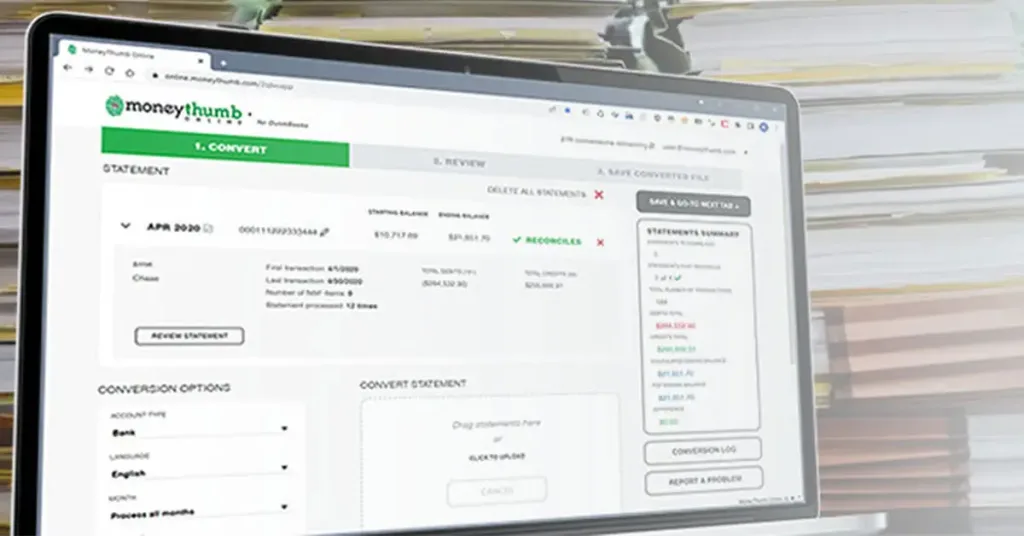
Here the conversion tools become essential. Here the most efficient tool MoneyThumb which helps you to convert bank statements, credit card reports, and financial documents into clean formats like Excel, CSV, or QBO. That means no more copy-paste work or manual typing.
How this improves accuracy across formats
Different banks structure their statements differently. Some use inconsistent date formats, others mix transaction types, and some even embed data in scanned PDFs.
A strong conversion tool handles:
- Automatic extraction of transaction data
- Standardization of dates, amounts, and descriptions
- Cleaning duplicates or formatting issues
- Exporting into accounting-ready formats
This directly answers a common concern: how to ensure data accuracy across different bank formats. Instead of relying on manual correction, the tool normalizes everything automatically.
2. Bank Statement Analysis (Improving Reconciliation Accuracy)
Reconciliation is useful for financial data to get validate. It’s also where most individuals lose time. When transactions don’t match, you end up checking entries one by one. This becomes even harder when dealing with multiple accounts or months of data.
Bank statement analysis tools simplify this process by organizing and matching transactions automatically.
What makes a high-accuracy reconciliation tool
Accuracy depends on how well the tool can match and validate data. The best tools:
- Automatically match transactions between sources
- Highlight missing or unmatched entries
- Detect duplicates and inconsistencies
- Maintain accuracy even with large datasets
Instead of manually verifying each transaction, you focus only on flagged issues. This alone can reduce reconciliation time dramatically while improving confidence in your numbers.
3. Automation Tools to Reduce Manual Data Entry
Manual data entry is one of the biggest sources of accounting errors. Even a small mistake can affect reports, balances, or tax calculations. Automation tools remove repetitive tasks and ensure consistency. They work by connecting different data sources and handling inputs automatically.
Practical ways to reduce manual entry errors
Improving accuracy isn’t just about tools it’s also about how the workflow is structured. A few practical adjustments can make a noticeable difference:
- Replace manual data entry with automated imports
- Use consistent file formats across all accounts
- Sync bank feeds instead of downloading statements repeatedly
- Schedule regular updates instead of processing data in bulk
When these changes are combined with automation tools, the result is a cleaner, faster workflow with fewer mistakes.
4. Fraud Detection and Pattern Recognition
In the fraud detection software clearly outperforms manual work is identifying unusual patterns in financial data. Fraud doesn’t always appear as a single obvious transaction. It often shows up as small, repeated irregularities that are easy to miss. Modern tools analyze transaction behavior over time and across accounts.
What these tools can detect
Instead of looking at transactions individually, these tools focus on patterns:
- Unusual spikes in deposits or withdrawals
- Repeated transactions with slight variations
- Irregular timing patterns
- Transactions that don’t match historical behavior
This type of analysis helps identify issues early before they become serious problems.
Detecting abnormal deposit patterns across multiple statements
When reviewing multiple accounts, patterns become more important than individual entries.
Effective tools can identify:
- Sudden increases in deposit frequency
- Structured deposits designed to avoid detection thresholds
- Consistent irregular patterns across different accounts
- Income streams that don’t align with expected behavior
This is especially useful for financial reviews, audits, and lending decisions where accuracy matters.
5. Investment Tracking and Portfolio Analysis
For individuals managing both income and investments, keeping everything organized in one place is essential. Switching between platforms creates confusion and increases the chance of missing key insights. Portfolio tracking tools combine financial data into a single view.
Why centralized tracking matters
Instead of checking multiple apps or statements, you can:
- View all investment accounts together
- Compare performance across assets
- Track growth over time
- Identify underperforming areas quickly
This not only saves time but also improves decision-making. When all data is visible in one place, it becomes easier to understand where money is working and where it’s not.
How Lenders Use These Tools to Speed Up Loan Reviews
Traditional loan processing often involves manual document review. This takes time and can lead to inconsistencies.
Modern lenders are shifting toward automated data processing to improve speed and accuracy.
How automation improves loan decisions
Instead of reviewing statements manually, lenders use tools to:
- Extract financial data instantly
- Standardize information across applicants
- Analyze cash flow and income patterns
- Identify risk indicators automatically
This reduces processing time significantly and allows faster decision-making without compromising accuracy.
White-Label Tools for Fintech Products
For those building financial platforms, creating data processing tools from scratch is not practical. White-label solutions provide ready-to-use technology that can be integrated into existing systems.
What to look for in a reliable solution
A strong white-label tool should offer:
- Accurate document parsing across formats
- Consistent data extraction
- Easy integration with existing systems
- Scalable performance for growing users
These tools allow businesses to focus on delivering value instead of building complex infrastructure.
Standardizing Financial Data Across Multiple Merchants
When dealing with multiple merchants or accounts, data inconsistency becomes a major issue.
Each source may use a different format, making comparison and reporting difficult.
Standardization tools solve this by converting all data into a unified structure.
Why standardization matters
Consistent data makes it easier to:
- Generate accurate reports
- Compare performance across accounts
- Identify trends and anomalies
- Integrate data into other systems
Without standardization, even the best analysis tools struggle to produce reliable results.
Best Practices to Improve Accuracy in Financial Workflows
Even the best tools need a structured workflow to deliver results.
Accuracy improves when processes are consistent and predictable.
A few key practices make a big difference:
- Use automated data extraction instead of manual entry
- Validate data immediately after import
- Keep formats consistent across all systems
- Reconcile data regularly instead of delaying it
- Use tools that flag inconsistencies early
These steps help maintain clean data and reduce the risk of errors over time.
Conclusion
The real challenge in individual accounting isn’t tracking transactions it’s managing clean, accurate, and consistent data across multiple sources. Once that problem is solved, everything else becomes easier: reconciliation, reporting, tax preparation, and even fraud detection.
This is where tools like MoneyThumb fit naturally into the workflow. Instead of replacing accounting software, they strengthen it by ensuring the data going in is already structured, reliable, and ready to use. That shift alone can save hours of work and prevent costly mistakes.
For individuals, the goal isn’t complexity. It’s clarity. The right combination of tools makes financial management simpler, faster, and far more accurate.
FAQs
What is the best accounting tool for individuals handling multiple bank formats?
The best option is a MoneyThumb tool that can convert and standardize data from different formats automatically. This ensures consistency and reduces manual work before the data enters your accounting system.
How can manual data entry errors be reduced in accounting?
Manual errors can be reduced by using automated data extraction, maintaining consistent file formats, and validating data immediately after importing it into the system.
Can accounting tools detect fraudulent bank statements?
Yes, modern tools can analyze transaction patterns and flag unusual activity that may indicate fraud, especially when reviewing large volumes of data.
Are white-label accounting tools useful for fintech platforms?
Yes, they allow fintech businesses to integrate reliable data processing without building complex systems from scratch, saving both time and development costs.
References
- https://www.moneythumb.com/blog/5-moneythumb-business-accounting-tools-for-individuals/
- https://www.moneythumb.com/pdf-to-excel-converter/
- https://www.moneythumb.com/2qbo-convert-pdf-to-qbo/
- https://quickbooks.intuit.com/accounting/what-is-bank-reconciliation/
- https://www.investopedia.com/terms/r/reconciliation.asp
- https://www.forbes.com/advisor/business/software/best-accounting-software/
- https://www.pwc.com/gx/en/services/consulting/financial-services/fintech.html
- https://www2.deloitte.com/us/en/pages/financial-services/articles/fintech-banking-industry.html
- https://www.mckinsey.com/industries/financial-services/our-insights/how-banks-can-better-serve-small-and-medium-size-enterprises

















One comment
Gwyn Thomas
i’m totally agree with you. These are the best accounting tools for every business owners. They should follow these tips to build up their business.