

Traditional lenders can speed up the loan underwriting process by automating document collection, extracting financial data directly from bank statements, using AI to verify documents, identifying inconsistencies early, and replacing manual data entry with automated workflows. These improvements reduce approval times, lower operating costs, improve fraud detection, and help banks compete with fintech lenders while maintaining strong underwriting standards.
Small business borrowers now expect financing decisions within hours rather than days.
The good news is that lenders no longer need to rebuild their entire lending platform to improve turnaround times. Modern document automation solutions, intelligent PDF analysis, and AI-assisted underwriting tools allow banks, credit unions, commercial lenders, and alternative finance companies to process applications much faster while maintaining accuracy and reducing fraud risk.
Why Underwriting Speed Matters More Than Ever
Loan underwriting has always balanced two competing priorities: making accurate lending decisions and delivering them quickly. Years ago, borrowers expected approval decisions to take several days or even weeks. Today, those expectations have changed dramatically.
Small businesses often seek financing because they need immediate working capital, inventory purchases, payroll funding, equipment financing, or expansion capital. Waiting a week for a lending decision can cause borrowers to accept offers from competitors that promise same-day approvals.
Faster underwriting benefits both borrowers and lenders. Borrowers receive funds sooner, while lenders process more applications without proportionally increasing staffing costs.
Some of the biggest business benefits include:
- Shorter loan approval times
- Higher customer satisfaction
- Increased application completion rates
- Better operational efficiency
- Lower underwriting costs
- Reduced manual errors
- Higher loan volume without expanding underwriting teams
Improving underwriting speed is no longer simply a customer service improvement. It has become a competitive requirement for lenders serving today's SMB market.
Where Traditional Underwriting Usually Slows Down
Most underwriting delays occur before an underwriter even begins evaluating credit risk. The biggest bottlenecks typically involve collecting, reviewing, verifying, and organizing financial documents submitted by applicants.
A typical SMB lending file may contain bank statements, tax returns, business financial statements, payroll reports, merchant processing statements, profit and loss reports, balance sheets, identification documents, and supporting business records. When these documents arrive in different formats and quality levels, underwriters spend valuable time preparing data instead of analyzing risk.
The most common sources of delay include:
| Underwriting Stage | Common Delay | Business Impact |
| Document collection | Missing or incomplete files | Longer application cycles |
| Data entry | Manual typing from PDFs | Higher labor costs |
| Statement review | Searching for deposits and expenses | Slower financial analysis |
| Fraud verification | Manual document inspection | Increased review time |
| Cash flow analysis | Spreadsheet preparation | Delayed credit decisions |
| Final review | Multiple back-and-forth requests | Customer frustration |
Removing these repetitive tasks allows underwriting teams to spend more time making informed lending decisions instead of performing administrative work.
Traditional Lenders vs. Fintechs: Why Speed Has Become a Competitive Advantage
Fintech lenders have invested heavily in automation over the last decade. Rather than relying on manual document reviews, they use software to collect financial documents, extract data automatically, identify unusual activity, and calculate financial metrics within minutes.
Traditional lenders often continue using workflows built around manual reviews, emailed documents, spreadsheets, and disconnected systems. While these methods can produce accurate decisions, they usually require much more time.
The comparison below highlights the operational differences.
| Traditional Lending | Modern Automated Lending |
| Manual document review | Automated document processing |
| Manual data entry | Automatic financial data extraction |
| Spreadsheet calculations | Real-time financial analysis |
| Human-only verification | AI-assisted document validation |
| Days for review | Hours or less for many applications |
| High administrative workload | Underwriters focus on risk analysis |
This does not mean lenders should replace experienced underwriters. Instead, technology removes repetitive work so experienced professionals can focus on evaluating creditworthiness, borrower risk, and lending decisions.
The Most Effective Strategies to Speed Up Loan Underwriting
Improving underwriting speed requires more than simply hiring additional staff. The greatest gains usually come from removing unnecessary manual work and standardizing the lending workflow. Several proven strategies consistently reduce turnaround times across commercial lending operations.
Automate Document Collection
Collecting documents through secure online portals reduces delays caused by missing paperwork and repeated email exchanges. Applicants receive clear upload instructions, lenders receive standardized document packages, and underwriters spend less time requesting additional information. Document checklists also improve application quality before underwriting begins.
Eliminate Manual Data Entry
One of the largest inefficiencies in lending is manually typing financial information from PDF bank statements into spreadsheets or loan origination systems.
Modern extraction software automatically captures:
- Deposits
- Withdrawals
- Daily balances
- Average balances
- NSF activity
- Monthly cash flow
- Income trends
- Expense categories
Instead of spending hours entering numbers, underwriters can immediately begin evaluating borrower performance.
Standardize Financial Analysis
Applications arrive with financial records from many different banks, accounting systems, and statement formats. Standardizing extracted financial data into a consistent structure allows underwriters to review every application using the same workflow. This improves consistency while reducing review time across the entire underwriting department.
Reduce Back-and-Forth Communication
Missing documents often extend underwriting by several days.
Automated validation during document submission can immediately identify:
- Missing statement pages
- Incorrect date ranges
- Low-quality scans
- Password-protected PDFs
- Unsupported file types
Applicants correct issues before underwriting begins, reducing unnecessary follow-up requests.
How AI Is Reducing Underwriting Turnaround Times
Artificial intelligence has become one of the most significant advances in commercial lending. Rather than replacing underwriting professionals, AI accelerates repetitive processes that previously consumed large amounts of time. AI can rapidly review financial documents, identify patterns, organize transaction data, and highlight unusual activity for human review.
Instead of manually inspecting hundreds of transactions, underwriters receive organized financial summaries within minutes.
AI is particularly effective for:
- Reading complex financial documents
- Extracting structured financial information
- Identifying inconsistent transaction patterns
- Highlighting unusual account activity
- Detecting duplicate information
- Categorizing income and expenses
- Supporting faster credit analysis
The result is a more efficient underwriting workflow without sacrificing lending quality.
The Growing Role of Document Automation
Document automation has become a key component of modern underwriting operations.
Rather than treating every uploaded PDF as an image requiring manual review, intelligent software converts financial documents into structured, searchable data that can be analyzed immediately. For SMB lending, this creates significant time savings because bank statements often represent the largest portion of financial review.
Automated document processing reduces:
- Manual document sorting
- Spreadsheet creation
- Copy-and-paste errors
- Repetitive calculations
- Administrative workload
- Processing bottlenecks
It also creates a consistent foundation for AI-driven underwriting tools and loan origination systems.
How MoneyThumb Helps Speed SMB Loan Underwriting
For lenders processing high volumes of small business loans, document quality and financial data extraction often determine how quickly underwriting can begin. This is where MoneyThumb provides practical value.
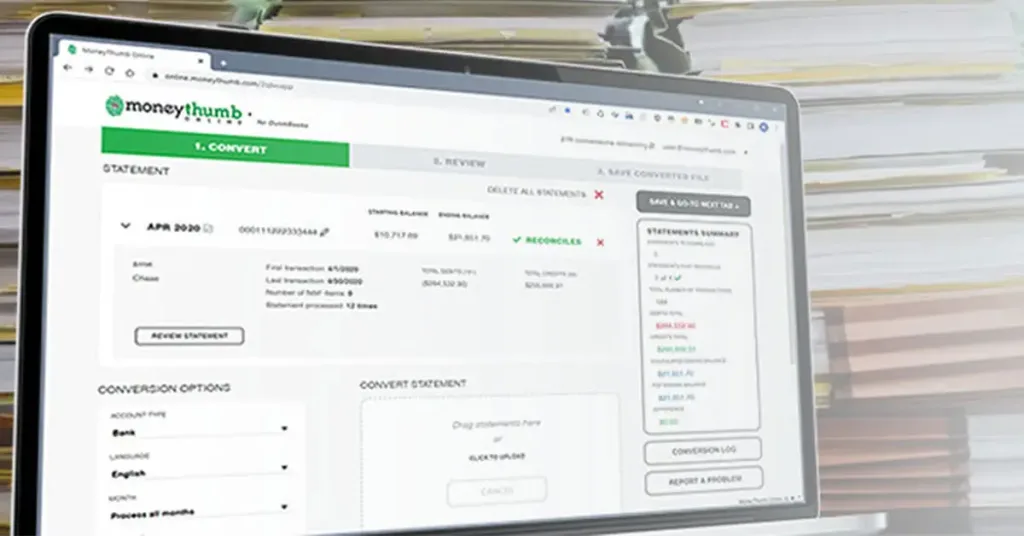
MoneyThumb specializes in converting complex financial PDFs into structured, usable data that fits directly into lending workflows. Instead of asking underwriters to manually review bank statements line by line, the software automatically extracts transaction details, balances, deposits, withdrawals, and cash-flow information from PDF statements generated by thousands of financial institutions.
This significantly reduces the time spent on manual data entry while giving underwriting teams standardized financial information that is ready for analysis.
MoneyThumb's solutions are particularly useful for:
- SMB lending
- Commercial lending
- Merchant cash advance providers
- Equipment financing
- Working capital loans
- Credit unions
- Community banks
- Alternative lenders
In addition to document conversion, MoneyThumb offers Thumbprint, a PDF forensic analysis solution designed to examine bank statements for signs of alteration or manipulation.
This combination of financial data extraction and PDF forensic analysis allows underwriting departments to review applications more quickly while strengthening document verification processes an increasingly important balance as lenders work to compete with fintech approval speeds.
Can MoneyThumb Help Underwriting Teams Spot Document Inconsistencies Faster?
One of the biggest challenges in commercial lending is determining whether submitted financial documents accurately represent a borrower's financial position. Modern PDF editing software has made it easier to alter bank statements, change balances, modify transactions, or recreate documents that appear legitimate at first glance.
Manual review alone is rarely enough to identify every alteration. Even experienced underwriters can overlook subtle changes when reviewing dozens of applications each day.
MoneyThumb addresses this challenge through Thumbprint, a PDF forensic analysis solution designed specifically for financial documents. Rather than examining only what is visible on the page, Thumbprint analyzes the internal structure of PDF files to identify signs that a document may have been modified or generated in an unusual way.
This helps underwriting teams focus their attention on applications that require additional review instead of manually inspecting every document in detail.
Benefits include:
- Faster identification of suspicious documents
- Reduced manual inspection time
- Better fraud prevention
- Improved underwriting confidence
- Consistent document verification
- Faster decision-making for legitimate borrowers
By identifying potential document issues earlier in the underwriting process, lenders can reduce delays while maintaining strong risk controls.
Fighting Loan Fraud While Increasing Processing Speed
Many lenders assume stronger fraud detection automatically means slower underwriting. In reality, modern automation allows both goals to work together. Instead of manually reviewing every uploaded document, automated verification tools quickly screen applications and flag only those that show unusual characteristics. Legitimate applications move through the workflow more efficiently, while higher-risk files receive additional attention from underwriters.
Examples of suspicious indicators include:
- Unusual formatting differences
- Inconsistent fonts or spacing
- Missing PDF objects
- Modified metadata
- Duplicate transaction patterns
- Unexplained balance changes
- Irregular document structures
Because only a smaller percentage of applications require deeper investigation, underwriting teams spend less time on routine reviews and more time evaluating genuine risks.
Best Practices for Traditional Lenders to Compete with Fintechs
Fintech companies have earned a reputation for rapid loan approvals, but speed is only one part of the customer experience. Traditional lenders continue to have strengths in relationship banking, industry knowledge, regulatory compliance, and long-term customer trust. Rather than trying to imitate every aspect of fintech lending, banks and commercial lenders can modernize specific parts of the underwriting process that create unnecessary delays.
Successful institutions generally focus on improving operational efficiency instead of replacing their entire lending platform.
The following best practices consistently produce measurable improvements:
- Automate financial document collection
- Eliminate manual bank statement data entry
- Standardize underwriting workflows
- Integrate document extraction into loan origination systems
- Use AI to organize financial information
- Apply automated document verification before manual review
- Train underwriters to focus on exceptions rather than routine processing
- Continuously measure turnaround times and workflow bottlenecks
These changes allow traditional lenders to reduce processing times while maintaining the personalized service many borrowers still value.
Why PDF Analysis Matters in Modern Lending
PDF bank statements remain one of the most commonly submitted financial documents during commercial loan underwriting.
Although they appear simple, PDF files contain layers of internal information beyond the visible document. These structural elements can provide valuable clues about how a file was created, edited, or processed.
MoneyThumb's PDF analysis capabilities help lenders evaluate documents beyond their visual appearance.
Rather than relying only on manual inspection, lenders can analyze:
- Internal PDF structure
- Embedded objects
- Rendering characteristics
- Metadata relationships
- File consistency
- Document integrity indicators
This additional visibility supports more informed underwriting decisions while reducing the amount of manual investigation required for each application.
Conclusion
Speed has become one of the most important competitive factors in small business lending. Borrowers expect quick responses, accurate decisions, and simple application experiences, while lenders must continue managing risk, maintaining compliance, and preventing fraud.
MoneyThumb supports this modern approach by helping lenders extract financial data from PDF bank statements and analyze document integrity through its Thumbprint forensic solution. Together, these capabilities reduce administrative workload, help identify potential document inconsistencies more quickly, and give underwriting teams structured financial information that supports faster, more confident lending decisions.
As competition from fintech lenders continues to grow, adopting intelligent document processing and automated underwriting support is becoming less of a competitive advantage and more of a business necessity.
References
- https://www.moneythumb.com/blog/how-lenders-can-speed-up-the-loan-underwriting-process/
- https://www.moneythumb.com/
- https://www.consumerfinance.gov/
- https://www.sba.gov/
- https://www.ffiec.gov/
- https://www.federalreserve.gov/
- https://www.icba.org/
- https://www.aba.com/
- https://www.nist.gov/
- https://www.fdic.gov/



















Add comment