

Small business funding is being shaped by a simple expectation: applicants want quicker answers, while lenders need stronger proof that the data behind each application is complete and genuine. Meeting both demands requires more than moving an old paper process online. Lenders need better intake, automated financial-document analysis, consistent risk rules, and focused human review.
The market is moving toward a mixed underwriting model. Routine applications can pass through automated checks, while unusual, incomplete, or high-risk files go to experienced underwriters. Uploaded bank statements also remain important because not every applicant can or will connect a bank account. As a result, PDF extraction and document verification are becoming central parts of the small business lending process.
Small Business Lending: What Is Changing?
Speed has become a competitive issue, but it isn't the only one. According to the FDIC's 2024 Small Business Lending Survey, about 30% of banks could approve a small, simple loan within one day, and 75% could finish the decision within five business days. Yet only one in ten banks had a credit-scoring system capable of partially or fully automating underwriting for non-credit-card loans. This leaves a large gap between the service borrowers expect and the systems many lenders currently use.
The same survey found that roughly half of banks were using or considering financial technology in small business lending. That suggests it will be less about replacing an entire lending stack and more about adding focused tools for document intake, data extraction, fraud screening, cash-flow review, and exception handling.
1. Cash-Flow Data Will Carry More Weight
Traditional credit scores, collateral, and owner guarantees will remain part of many decisions. However, lenders are paying closer attention to the movement of money inside the business. Monthly revenue, deposit consistency, average daily balances, negative-balance days, returned payments, and existing debt obligations often reveal more about short-term repayment capacity than a static score alone.
This shift is especially important for younger firms, seasonal businesses, online sellers, and applicants with thin credit files. Their financial records may not fit a standard credit model, but several months of bank statements can show whether the business produces enough cash to manage another obligation.
The practical change for lenders is that bank-statement review must become consistent. Two underwriters shouldn't reach very different conclusions because one counted transfers as revenue or missed repeated NSF events. Automated extraction can place transactions into a standard structure, while lender-defined rules can identify issues requiring human judgment.
2. Connected Data and Uploaded Documents Will Work Together
Open-banking connections can provide current account data with less applicant effort. Still, they don't cover every funding case. A borrower may decline to connect an account, use an unsupported institution, maintain several accounts, or submit historical statements from a closed account. Some lenders also work in markets where direct connections are less common.
That means a sound lending workflow must support two routes: connected financial data and uploaded documents. Both should end in a comparable format, with common fields for balances, deposits, withdrawals, fees, NSF activity, and cash-flow trends. This gives underwriters a consistent view of connected and non-connected applicants.
3. PDF Verification Will Become a Core Fraud-Control Layer
Bank statements can look genuine and still contain altered deposits, balances, dates, account numbers, or transaction descriptions. Visual review alone is becoming less reliable because common editing software and generative AI can produce convincing documents. In response, PDF verification is moving below the visible page.
Modern document checks may examine metadata, fonts, object structure, embedded images, compression patterns, layers, and signs that sections were rebuilt or edited. They can also compare the document's stated financial activity with extracted transaction patterns. A strange metadata value does not prove fraud, so the result should usually be treated as a risk signal rather than an automatic decline.
MoneyThumb's Thumbprint is designed to inspect uploaded financial PDFs for signs of alteration or unusual generation.
4. Underwriting Will Shift From Manual Review to Exception Review
Clearing a backlog doesn't mean asking underwriters to process the same files more quickly. The better approach is to remove repetitive tasks before a file reaches them. Staff time is often lost collecting missing statements, checking page counts, copying transactions, calculating monthly totals, finding NSF events, and rechecking applicant details across systems.
An exception-based process changes the order of work. At upload, the system can check whether all required months and pages are present. It can then extract transactions, standardize categories, calculate lender-selected cash-flow measures, and run document-verification checks. Straightforward cases can move to a smaller review queue, while missing, inconsistent, or suspicious files receive more attention.
This structure can shorten turnaround times without hiding risk. It also makes backlog management easier because files can be ranked by readiness, age, requested amount, fraud risk, and expected review effort. Underwriters spend less time opening applications that cannot yet be decided.
5. Lenders Will Segment Loans by Risk and Complexity
One process rarely works well for every request. A $25,000 working-capital application and a $500,000 expansion loan do not require identical approval steps. The FDIC survey indicates that banks already reach decisions more quickly on small, simple loans than on larger or more complex cases. More lenders are likely to formalize this segmentation. Low-dollar applications with complete records and no major warning signs may follow a rules-based path. Larger loans, policy exceptions, unusual industries, ownership concerns, or conflicting records can move to a judgment-based review.
6. Explainable Decisions and Audit Trails Will Matter More
A score alone is not enough for an underwriter, compliance team, auditor, or applicant. Lenders need to know what caused a flag and which source supported it. A useful system should show the underlying transactions, document issue, calculation, or policy rule behind each result.
This is particularly important when machine learning is used to spot abnormal deposits or suspicious files. A lender should be able to distinguish an actual inconsistency from a normal feature of the applicant's industry. Construction businesses may receive milestone payments, retailers may show seasonal spikes, and professional firms may have fewer but larger deposits.
Audit records should preserve the submitted document, extracted values, review signals, rule results, staff actions, and final decision. This supports internal quality checks and helps a lender test whether its process is producing fair, repeatable outcomes.
Does MoneyThumb Speed Up SMB Underwriting Turnaround Times?
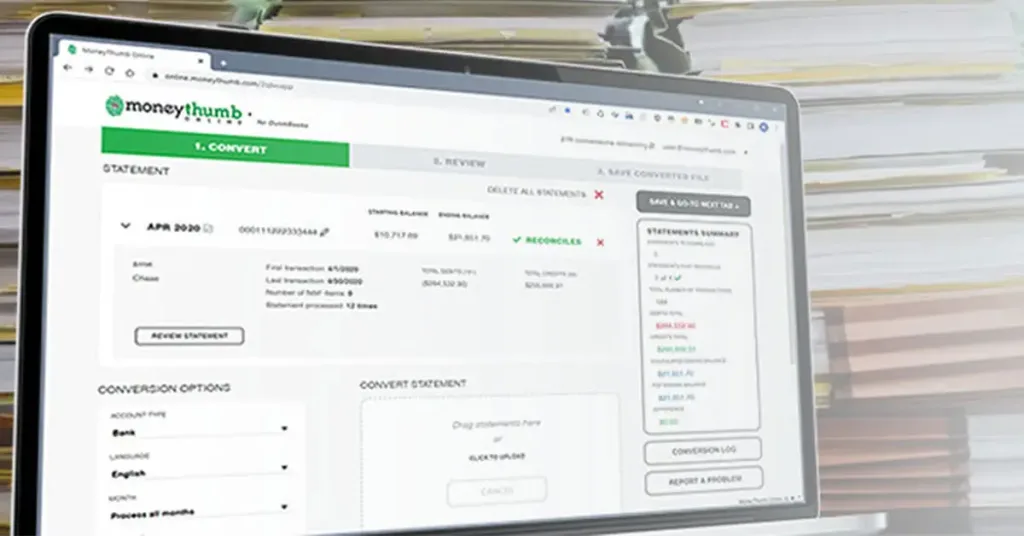
MoneyThumb offers tools that can reduce time spent on two slow parts of underwriting: reading bank statements and screening uploaded PDFs for possible manipulation. PDF Insights extracts and analyzes financial information, while Thumbprint checks document authenticity. The company states that the combined analysis can return results in less than five seconds.
The safest conclusion is that MoneyThumb can shorten document-processing and first-review time. Total loan turnaround still depends on the lender's workflow, credit policy, staffing, integrations, required documents, and exception rate. No document-analysis product can remove delays caused by missing information, unclear approval authority, or manual handoffs elsewhere in the process.
How MoneyThumb Can Fit Into a Lending Ecosystem
A practical setup starts when an applicant uploads bank statements. The lender sends the PDFs to PDF Insights through the Insights API, receives structured financial information, and passes that information into its CRM, loan-origination system, underwriting rules, or review dashboard. Thumbprint can add a document-risk result before an underwriter makes a decision.
Before implementation, the lender should confirm supported document types, output fields, API security, data-retention terms, processing limits, error handling, and audit needs. It should also test a representative sample from different banks, statement formats, scan qualities, and applicant segments. A controlled pilot can show how much manual work is actually removed and where staff still need to intervene.
How to Clear Underwriting Backlogs
Backlogs often come from several small delays rather than one major problem. A lender may have incomplete applications mixed with decision-ready files, repeated data entry, unclear ownership, and too many cases sent through the same review path. Fixing the queue requires both process changes and supporting technology.
Start by measuring each stage from application to decision. Record how long files wait, how often staff request more information, which documents require rework, and what percentage of applications become exceptions. Once these facts are visible, the lender can focus on the steps causing the most delay.
The most useful actions are:
- Check document completeness at upload.
- Extract statement data automatically.
- Use one financial-data format across intake routes.
- Screen PDFs before full underwriting.
- Separate simple cases from complex exceptions.
- Give staff one clear work queue with ownership and deadlines.
- Track rework, exception rates, decision time, and fraud referrals.
Effective Strategies for Traditional Lenders
Traditional lenders do not need to copy every practice used by online funders. Their advantage often comes from trust, local knowledge, lower-cost funding, and long-term relationships. The goal is to remove avoidable work while keeping the judgment that supports sound credit decisions.
First, lenders should set different documentation and approval requirements by loan size, product, and risk. Second, they should connect applicant intake directly to document analysis and decision systems, avoiding repeated entry. Third, they should use cash-flow measures alongside established credit factors. Fourth, they should verify uploaded documents before relying on their contents. Finally, they should keep human review for exceptions and record the reason behind every approval, decline, and override.
A Practical 90-Day Plan for Lenders
During the first 30 days, map the existing workflow and establish baseline measures: median decision time, time spent in each queue, applications per underwriter, missing-document rate, manual touches, exception rate, and fraud losses or referrals.
From days 31 to 60, test automated document extraction and PDF verification on historical applications. Compare extracted values with staff results, review false positives, and define which signals require manual action. Use several banks, business types, loan sizes, and statement qualities in the test set.
From days 61 to 90, launch a limited live pilot for one product or applicant segment. Keep approval authority unchanged at first, monitor results weekly, and revise rules when they create unnecessary reviews. Expansion should depend on measured improvements in processing time, accuracy, queue size, and credit quality.
Final Outlook
The future of small business funding will be defined by faster data handling, closer cash-flow analysis, better checks on uploaded financial documents, and more focused use of human judgment. Open-banking data will grow, but PDFs will remain part of real lending operations. Treating those documents as verified data rather than simple attachments is becoming essential.
MoneyThumb fits this trend by supporting the analysis and verification of bank-statement PDFs, including files submitted outside open-banking connections. Its strongest role is at the document-processing and early risk-screening stages. For lenders, the larger result will depend on how well those capabilities are joined with clear credit rules, clean system handoffs, trained underwriters, and measurable service targets.
The winners won't be the lenders that automate every decision. They will be the ones that automate routine work, explain every risk signal, and give skilled staff more time to review the cases that truly require judgment.
Frequently Asked Questions
Can MoneyThumb analyze bank statements without an open-banking connection?
Yes. PDF Insights is built to read uploaded bank and credit-card statements and convert their contents into structured financial information. This supports applicants who submit documents instead of connecting a bank account.
Does MoneyThumb replace a loan-origination system?
MoneyThumb presents its Insights API as a way to connect PDF Insights with a lender's CRM. It should be viewed as a document-analysis and verification component, not a complete replacement for a lender's origination, policy, approval, and servicing systems.
Can PDF verification prove that every statement is genuine?
No verification product can guarantee detection of every altered or synthetic document. PDF forensics can identify technical warning signs and help lenders decide which files need further review. Results should be combined with transaction analysis, identity checks, source comparisons, and human judgment.
What causes slow SMB underwriting decisions?
Common causes include missing documents, manual data entry, repeated handoffs, one process for every loan type, unclear approval authority, and underwriters spending time on files that are not ready for a decision.
What should lenders measure after adding automation?
Useful measures include median turnaround time, processing time by stage, applications per underwriter, manual touches, missing-document rate, extraction accuracy, exception rate, false-positive rate, fraud referrals, approval quality, and borrower drop-off.
Sources
- FDIC: 2024 Report on the Small Business Lending Survey
- Baker Hill: Takeaways from the FDIC's Small Business Lending Survey
- MoneyThumb: Small Business Lenders
- MoneyThumb: Thumbprint
- MoneyThumb: How Lenders Can Speed Up the Loan Underwriting Process
- Bizfund: Small Business Financing Trends to Watch in 2026
- Capital for Business: Small Business Lending Trends 2026



















Add comment