

Automated financial spreading can improve a lender’s credit workflow by converting borrower financial documents into structured, standardized data that underwriters can review without repeatedly entering figures by hand. Modern systems can extract financial statement data, calculate ratios, organize cash flow information, trace figures back to source documents, and pass structured outputs into credit workflows. Fraud screening and bank statement analysis can then add another layer by identifying NSFs, unusual deposits, altered PDFs, and other risk signals.
For commercial banks, SMB lenders, credit unions, asset-based lenders, and MCA funders, the goal isn’t simply faster document processing. The real value comes from giving analysts consistent data while leaving final credit decisions with qualified people who can review the complete borrower file.
What Is Automated Financial Spreading?
Automated financial spreading is the process of extracting financial information from borrower documents and placing it into a lender’s standardized credit analysis format. Depending on the system, this may include income statements, balance sheets, cash flow statements, tax returns, personal financial statements, bank statements, and supporting schedules.
Instead of an analyst reading each page and entering every figure into Excel or another template, software identifies relevant values and assigns them to standardized fields. Some systems also calculate financial ratios, debt service coverage, global cash flow, period comparisons, and other underwriting measures. Source traceability can help analysts verify where each extracted figure originated.
Manual Spreading vs. Automated Financial Spreading
The difference becomes clearer when the two workflows are compared side by side. Manual spreading still gives analysts direct control, but the repeated data-entry work can limit capacity as application volume increases.
| Credit workflow area | Manual process | Automated financial spreading |
| Document review | Analyst reads documents individually | Software extracts relevant fields |
| Data entry | Figures entered by hand | Values mapped into standard fields |
| Standardization | Depends heavily on analyst process | Rules can be applied consistently |
| Ratio calculations | Spreadsheet formulas or manual calculations | Calculated from structured data |
| Source review | Analyst returns to original PDF | Some systems link figures to source pages |
| Multi-period comparison | Built manually | Periods can be normalized automatically |
| Credit memo preparation | Data copied between systems | Structured outputs can feed downstream workflows |
| Fraud review | Separate manual checks | Can be paired with document verification tools |
This doesn’t mean every credit decision should become automatic. It means analysts can spend less time entering information and more time reviewing exceptions, borrower performance, documentation quality, and policy compliance.
Why Manual Financial Spreading Creates Credit Bottlenecks
Traditional spreading often involves several handoffs. A borrower submits documents, an analyst classifies them, financial figures are entered into a spreadsheet, ratios are calculated, numbers are checked again, and selected information is copied into the credit memo or loan origination system.
Each handoff creates another place where figures may be typed incorrectly, mapped inconsistently, or become outdated. Statement-spreading software is a way to reduce repeated entry, maintain source traceability, and move spread information into broader credit analysis. Its public material also reports customer examples involving substantial time savings per loan, although results naturally vary by institution and workflow.
Standardized Data Makes Credit Analysis More Consistent
Standardization is one of the biggest operational benefits of financial spreading. Two analysts reviewing the same borrower shouldn’t produce materially different calculations simply because they organized the source documents differently.
A standardized system can map common accounting categories into the institution’s chosen credit structure. That helps teams compare current results with prior periods, apply internal calculations consistently, and identify exceptions that deserve manual attention.
Financial Spreading and Bank Statement Analysis Are Not the Same
Financial spreading and bank statement analysis are closely related, but lenders shouldn’t treat them as identical.
Financial spreading normally organizes accounting and tax information into standardized credit fields. Bank statement analysis works at transaction level, examining deposits, withdrawals, balances, lender payments, NSF activity, overdrafts, revenue patterns, and other cash flow indicators.
A lender may therefore use one system for financial spreading and another system for bank statement parsing, cash flow analytics, or document authentication. Some newer platforms cover several of these functions in one product, but the underlying tasks remain different.
Understanding this distinction prevents a lender from buying a spreadsheet replacement and assuming it also provides document-forensics capability.
How Automated Bank Statement Analysis Supports Spreading
Bank statements can provide a current view of actual cash movement when tax returns or annual financial statements are several months old. Software can convert transactions into structured fields that underwriters can compare across accounts and periods.
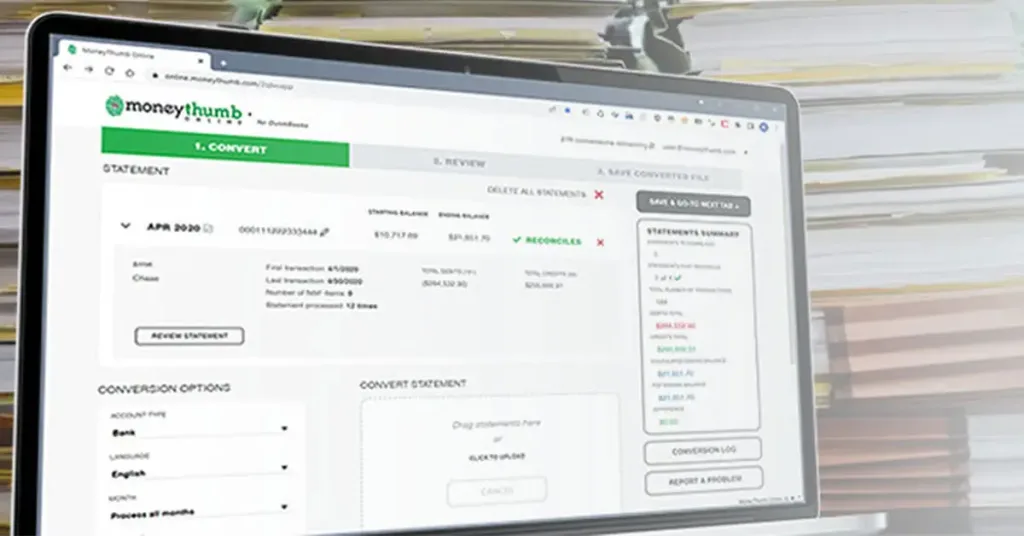
MoneyThumb’s PDF Insights, for example, extracts information from bank statements and related financial documents while producing cash flow and underwriting information. Its lender material describes outputs such as true revenue, negative-balance days, low-balance days, debt obligations, and other statement-level factors. MoneyThumb states that its processing supports statements from more than 99% of U.S. banks.
These figures are vendor-published claims, so lenders should test accuracy using their own document mix before relying on them operationally.
Automating NSF and Overdraft Identification
NSF activity can reveal short-term liquidity pressure that may not be obvious from revenue totals alone. Finding those events manually becomes difficult when an application includes several accounts covering many months.
Statement-analysis software can classify transaction descriptions, identify NSF or overdraft fees, track negative balance days, and compare events across statement periods. MoneyThumb specifically lists ODs, NSFs, negative transactions, low balances, debt obligations, and non-reconciled summaries among the signals available through its lender workflow.
Automation makes the events easier to locate. An underwriter still needs to interpret their meaning within the borrower’s business cycle, available liquidity, account structure, and overall credit file.
Catching Doctored Bank Statements Requires a Fraud Layer
A perfectly calculated spread can still be unreliable if the source document has been altered. That’s why statement extraction and document authentication should be treated as separate controls.
MoneyThumb’s Thumbprint compares document characteristics with known characteristics from statements issued by the same financial institution. It looks at factors such as layout, font usage, transaction positioning, copied lines, balance changes, and formatting inconsistencies. Its documentation describes the product as looking for both internal document inconsistencies and differences from expected bank-statement structures.
What Does Implementation Usually Involve?
There isn’t a credible single implementation timeline that applies to every lender. None of the three vendors above publishes one standard LOS deployment duration covering every customer configuration.
A dashboard-only pilot is different from an API integration connected to a production LOS, decision engine, CRM, or credit memo workflow. A production rollout may require security review, data mapping, API testing, document-type validation, user permissions, policy configuration, exception handling, and quality testing.
MoneyThumb provides API/JSON output, webhook notifications, configurable payload sections, and implementation support on its enterprise offering.
Connected and Non-Connected Borrowers Need the Same Data Model
One challenge for commercial lenders is that borrower information doesn’t always arrive through a bank connection. Some merchants authorize connected account data, while others upload PDF statements, scans, tax forms, or accounting reports.
A strong workflow should normalize these inputs before credit analysis. The lender shouldn’t maintain one completely different set of calculations for connected accounts and another for uploaded documents. MoneyThumb supports PDF and JSON inputs, while other platforms provide APIs for structured statement data. The practical target is consistent financial fields regardless of how the source arrived.
Automated Spreading Should Support Credit Policy, Not Replace It
Software can extract figures, apply formulas, identify anomalies, and organize information, but credit policy still belongs to the financial institution.
A cash flow system may identify an NSF. A fraud tool may flag unusual document formatting. A spreading system may calculate DSCR. None of those individual outputs explains the entire borrower situation.
Credit teams should define which findings require review, what evidence resolves an exception, which calculations apply to each lending product, and who can approve overrides. Automated systems work most reliably when they operate inside documented underwriting policies rather than making uncontrolled credit decisions on their own.
How to Evaluate Financial Spreading Software
The strongest product evaluation uses actual borrower files rather than vendor-created samples. Give competing systems difficult tax returns, scanned statements, multiple accounts, unusual bank formats, multi-entity relationships, amended documents, and files containing known exceptions.
Then compare whether the system extracts the right figures, preserves source references, calculates ratios according to your policy, finds NSFs correctly, identifies existing obligations, handles multiple periods, and explains fraud warnings.
Also check what happens when confidence is low. A useful system should make uncertain data easy to review instead of hiding uncertainty behind a single score.
Pricing Should Be Compared Against the Whole Workflow
Software cost per document is only one part of the business case. Lenders should also consider analyst hours, manual data entry, duplicate review, integration costs, fraud losses, rework, and the cost of moving information between systems.
MoneyThumb currently publishes consumption-based pricing starting at $599.95 per year and states it doesn’t charge extra per API call, additional page, or user seat under the described model.
FAQ: Can Automated Financial Spreading Detect Fake Bank Statements?
Can Financial Spreading Software Identify NSFs?
Yes, when the platform includes transaction-level bank statement analysis. Software can identify NSF fees, overdrafts, negative balance days, and related transaction patterns. The underwriter should then evaluate frequency, timing, cash balances, seasonality, and the wider borrower file before drawing a credit conclusion.
Does Automated Financial Spreading Integrate with an LOS?
Many products provide APIs, structured data outputs, or webhooks that can connect analysis with a loan origination or credit workflow. Integration depth varies by vendor and LOS. Lenders should test field mapping, exception handling, source links, user permissions, and data synchronization before moving from a pilot into production.
Does Automated Spreading Replace Credit Analysts?
No. It can reduce document classification, data entry, ratio calculation, and initial risk-screening work, but experienced analysts are still needed to interpret unusual cash flow, investigate fraud signals, apply credit policy, review exceptions, and make authorized lending decisions.
Conclusion
Automated financial spreading gives lenders a practical way to reduce repetitive data entry and create a more consistent path from borrower documents to credit analysis. The strongest workflows combine financial statement spreading, bank statement parsing, transaction analysis, source traceability, and document verification rather than expecting one extraction tool to solve every underwriting problem.
The right setup depends on document mix, loan volume, existing LOS infrastructure, credit policy, and how much manual review the institution wants to retain.
For lenders evaluating these systems, the key test is simple: run real borrower files through each platform and measure extraction quality, exception handling, traceability, fraud explanations, integration fit, and analyst time saved. Software should prepare better information for the credit team, while qualified people remain responsible for the final lending decision.












Add comment